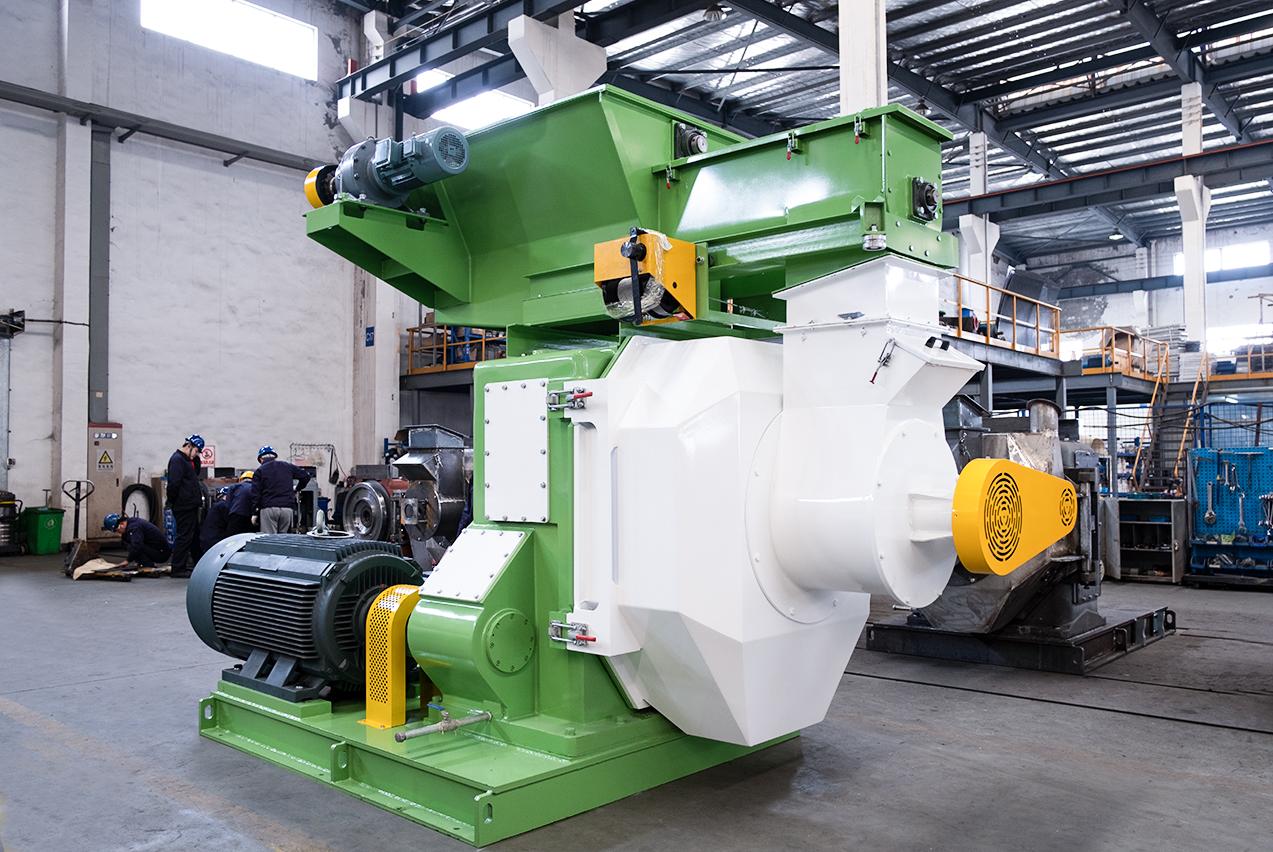
Industrial Biomass Wood Pellet Press Making Machines — Kingwood
JZWH-860 Horizontal Biomass Pellet Mill: Technical Overview
The JZWH-860 is Kingwood’s horizontal ring die pellet mill, engineered for continuous industrial-scale biomass pellet production at 4–5 metric tons per hour. Unlike flat-die configurations, the horizontal ring die design distributes compression forces symmetrically across the die surface, reducing localized wear and extending service intervals under sustained high-load operation.
The drivetrain centers on a self-developed high-precision, high-strength hardened-gear transmission box. This assembly is purpose-built for biomass feedstocks—which impose variable torque loads due to differences in fiber density, moisture gradient, and particle geometry. The gearbox tolerates these fluctuations without backlash accumulation, maintaining pellet dimension consistency across production shifts.
Key mechanical specifications relevant to procurement decisions:
- Rated output: 4–5 t/h of finished biomass pellets
- Die configuration: Horizontal ring die
- Transmission: Proprietary hardened-gear gearbox
- Pellet quality: Calorific value 4,800 kcal/kg; moisture <15%; sulfur <0.3%; ash <18%
- Certifications: ISO 9001, ISO 14001, CE
Pellets produced on the JZWH-860 meet emissions thresholds below China’s GB13271-2001 national boiler air pollutant standard, and satisfy EU moisture (<15%), US calorific (>2,500 kcal/kg), Japanese sulfur (≤0.5%), and ISO ash (<20%) requirements.
Custom Configuration for Industrial Biomass Wood Pellet Press Projects
No two biomass fuel operations share identical feedstock profiles, site constraints, or throughput targets. Kingwood’s engineering model—built on 27 years of R&D and a dedicated team of 20 R&D experts—supports full custom configuration of biomass wood pellet press making machines from initial process design through commissioning.
Configurable parameters include:
- Feedstock type: Wood chips, agricultural residues, forestry by-products, mixed biomass
- Incoming moisture range: Wet-feed lines handle high-moisture material through integrated drying prior to pelletizing
- Throughput target: Single-machine JZWH-860 units at 4–5 t/h, or multi-line arrangements scaled to complete line capacity up to 200,000 metric tons per year
- Automation level: Fully automated, enclosed processing with integrated dust removal per Kingwood’s Three-Standardization Framework (Integrated, Dust-Free, and Automated production lines)
- Auxiliary equipment integration: Drum chipper, hammer mill, drum dryer, counter-flow cooler, and pellet packaging machine sourced and integrated by Kingwood as a single-vendor complete line
The Three-Standardization Framework is Kingwood’s structural differentiator. Rather than supplying standalone machines, Kingwood engineers complete wet-feed pellet production lines where each process stage—crushing, coarse grinding, drying, fine grinding, pelletizing, cooling, and packaging—is sequenced, automated, and enclosed. This eliminates the integration risk that arises when buyers source equipment from multiple vendors.
For buyers evaluating complete line investment, the 30 t/h wood pellet mill project in Chongqing, China provides a documented commissioning reference at scale.
Deployed Performance: International Project Data
Kingwood equipment is operating across 30 countries. The following projects provide procurement-relevant benchmarks:
Vietnam — 24 t/h wood chip pellet line (2023) A full wet-feed line commissioned in Vietnam in 2023 processes wood chip feedstock at 24 t/h. This project demonstrates Kingwood’s capacity to deliver and commission large-scale lines within Southeast Asian regulatory and infrastructure environments. View project details.
Vietnam — 12 t/h line, 23-month payback (2024) A 12 t/h biomass pellet production line commissioned in 2024 achieved full capital recovery within 23 months. The payback period reflects both the 40–50% fuel cost advantage of biomass pellets over fossil alternatives and the production uptime sustained by Kingwood’s drivetrain and control architecture. View project details.
China — Guizhou Dust-Free workshop (2024) A Dust-Free production line facility built in Guizhou in 2024 demonstrates the enclosed, dust-controlled implementation of the Three-Standardization Framework in an active manufacturing environment. View project details.
Across more than 2,000 planned and designed production line projects, Kingwood’s installed base supports a combined annual biomass fuel production capacity of 10 million metric tons.
Procurement and Specification Guidance
Jiangsu Kingwood Industrial Co., Ltd. (NEEQ: 871765) is headquartered at #568 Hongsheng Road, Liyang Zhongguancun Industrial Park, Liyang City, Jiangsu Province, China. The company operates a 25,000 m² production facility alongside a 6,200 m² office campus.
For buyers sourcing industrial biomass wood pellet press making machines, Kingwood’s standard engagement process covers:
- Feedstock and site assessment — technical review of raw material characteristics and facility constraints
- Line architecture proposal — equipment selection, capacity modeling, and automation scope
- Quotation and lead time — based on confirmed specification; JWZL-1068 and JZWH-860 lead times available on request
- Factory acceptance and commissioning support — Kingwood technicians provide on-site commissioning support internationally
Contact Kingwood’s sales engineering team with feedstock type, target throughput, and project location to initiate a technical proposal.
FAQ
What is the throughput capacity of the JZWH-860 biomass pellet press?
The JZWH-860 horizontal biomass pellet mill delivers 4–5 metric tons per hour of finished biomass pellets, suitable for mid-to-large industrial production lines.
Can Kingwood configure a custom biomass wood pellet press for specific feedstock or facility requirements?
Yes. Kingwood's engineering team designs custom-configured pellet press solutions tailored to feedstock type, moisture content, facility layout, and target output—contact sales for a technical assessment.
What complete production line does Kingwood offer alongside the pellet press?
Kingwood supplies wet-feed biomass pellet production lines up to 200,000 metric tons per year capacity, integrating a drum chipper, hammer mill, drum dryer, ring die pellet mill, counter-flow cooler, and pellet packaging machine in a fully automated, dust-free enclosure.
What quality and compliance certifications does the JZWH-860 carry?
The JZWH-860 and Kingwood's manufacturing operations are certified to ISO 9001, ISO 14001, and CE standards. Kingwood is also recognized as a Jiangsu Provincial High-Tech Enterprise.
What calorific value do biomass pellets produced on Kingwood equipment achieve?
Biomass pellets produced on Kingwood lines achieve a calorific value of 4,800 kcal/kg, with moisture content below 15%, sulfur content below 0.3%, and ash content below 18%—meeting EU, US, Japanese, and Chinese GB standards.
How much can biomass pellets reduce fuel costs compared to fossil alternatives?
Kingwood-produced biomass pellets reduce fuel costs by 40–50% compared to conventional fossil fuels, based on operational data from deployed production lines.
Where are Kingwood biomass pellet press machines deployed internationally?
Kingwood equipment operates across 30 countries. Documented projects include a 24 t/h wood pellet line in Vietnam (2023), a 12 t/h line in Vietnam with a 23-month payback period (2024), and a 30 t/h installation in Chongqing, China (2021).