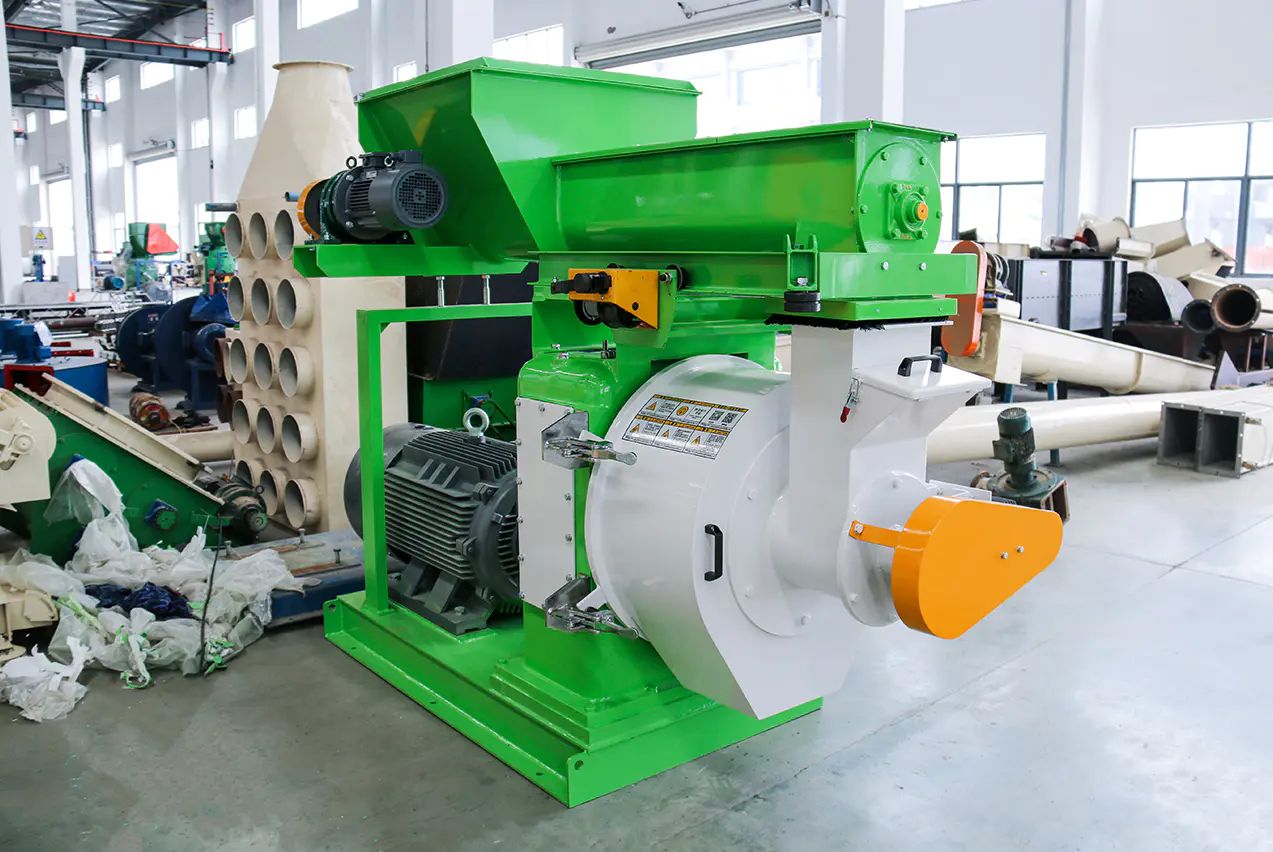
JWZL-420 Biomass Wood Pellet Mill: 1–1.5 t/h Capacity
Capacity: 1–1.5 t/h
JWZL-420 Vertical Biomass Pellet Mill: Technical Overview
The JWZL-420 is Kingwood’s entry-level industrial vertical ring die pellet mill, rated at 1–1.5 metric tons per hour. It is purpose-built for biomass feedstocks that present pelleting challenges at lower capital budgets — including rice husk, sawdust, wood shavings, crop straw, and mixed agricultural residues.
Unlike flat-die machines common in sub-industrial segments, the JWZL-420 uses a vertical ring die configuration. This geometry delivers higher transmission efficiency, reduced mechanical heat loss, and lower noise output compared to horizontal flat-die alternatives. The vertical orientation also promotes more even feedstock distribution across the die face — a critical advantage when processing low-bulk-density materials such as rice husk.
| Parameter | Specification |
|---|---|
| Model | JWZL-420 |
| Configuration | Vertical ring die |
| Rated capacity | 1–1.5 t/h |
| Target feedstocks | Rice husk, wood chips, sawdust, agricultural straw |
| Certifications | ISO 9001, ISO 14001, CE |
For operations requiring higher throughput, Kingwood’s pellet mill lineup scales directly from the JWZL-420: the JWZL-688 (2–2.3 t/h), JWZL-688D (3–3.5 t/h), JWZL-928 (4–5 t/h), and JZWH-860 horizontal model each address larger project economics without requiring a change in process architecture.
Processing Rice Husk and Wood Waste: Feedstock Considerations
Rice husk is one of the more demanding biomass feedstocks for pelletizing. Its high silica content — typically 15–20% SiO₂ by mass — accelerates die wear and produces pellets with elevated ash content relative to clean woody biomass. Operators must account for this in feedstock pre-treatment planning and equipment selection.
For rice husk applications, Kingwood recommends the following upstream process steps before material reaches the JWZL-420:
- Size reduction — A hammer mill reduces particle size to the 3–5 mm range required for consistent die compression and uniform pellet geometry.
- Moisture conditioning — A drum dryer brings feedstock moisture below 15%, the threshold required to achieve pellet density and mechanical durability meeting EU EN ISO 17225 and China national standards.
- Controlled feed rate — The JWZL-420’s feed system is calibrated to handle variable bulk densities, preventing bridging or die plugging common with husk-type materials.
For wood waste streams — sawmill offcuts, wood chips, planer shavings — a drum chipper upstream of the hammer mill handles oversized input before it enters the grinding circuit. Kingwood’s complete wet-feed biomass pellet production lines process high-moisture inputs (green wood, fresh agricultural residue) through a fully sequenced workflow: coarse chipping → drying → fine grinding → pelletizing → cooling → packaging, all within an enclosed, dust-controlled environment.
Finished pellets produced through this process achieve a calorific value of 4,800 kcal/kg, moisture below 15%, sulfur below 0.3%, and ash below 18% — satisfying fuel specification thresholds required by industrial boiler operators across China, the EU, Japan, and Southeast Asian markets. These figures confirm compliance with GB13271-2001, China’s national emission standard for boiler air pollutants.
Three-Standardization Framework: Application to JWZL-420 Production Lines
Kingwood’s Three-Standardization Framework is the engineering philosophy applied to every production line the company designs and commissions — including those built around the JWZL-420. The three pillars are:
- Integrated production lines — All process stages from raw material intake to packaged pellet output are connected in a single, continuous layout. This eliminates inter-stage material handling bottlenecks and reduces labor requirements across shifts.
- Dust-Free production lines — Enclosed conveyors, sealed transfer points, and integrated dust collection systems contain particulate emissions within the facility boundary. This meets regulatory requirements in China and reflects best-practice expectations in EU and Southeast Asian operating environments. Refer to the dust-free biomass pellet mill workshop case study from Guizhou (2024) for a documented installation reference.
- Automated production lines — PLC-based control systems manage feed rate, die temperature, motor load, and discharge, reducing operator dependency and maintaining output consistency across production shifts.
For a 1–1.5 t/h JWZL-420 line, full automation is achievable within a compact footprint. This makes the configuration viable for industrial parks, agricultural cooperatives, and regional fuel producers that require audit-ready, compliant operations without the capital expenditure of a large-scale plant.
Production Economics and Deployment Context
Biomass pellets produced on a JWZL-420-based line offer industrial fuel buyers a 40–50% reduction in fuel costs versus equivalent fossil fuel inputs at comparable calorific output. For boiler operators currently burning coal or heavy oil, this represents a material improvement in operating economics — alongside compliance benefits under tightening national and regional emission regulations.
Kingwood has planned and engineered over 2,000 production line projects across 30+ countries since its founding in 1999, giving its engineering team documented commissioning experience across varied feedstock conditions, regulatory environments, and infrastructure constraints. Recent reference installations include a 12 t/h wood pellet line in Vietnam (2024) with a verified 23-month payback period and a 24 t/h wood chip pellet line in Vietnam (2023) — both markets where rice husk and mixed wood residues are the dominant feedstock.
For buyers evaluating the JWZL-420 as the core machine for a new pellet production facility, Kingwood’s standard project scope includes feedstock assessment, line layout engineering, equipment supply, installation supervision, operator training, and after-sales technical support.
Jiangsu Kingwood Industrial Co., Ltd. is listed on China’s NEEQ exchange (stock code: 871765), headquartered at #568 Hongsheng Road, Liyang City, Jiangsu Province. Contact Kingwood’s sales engineering team for feedstock-specific capacity modelling and project quotation.
FAQ
What is the production capacity of the JWZL-420 biomass pellet mill?
The JWZL-420 delivers a rated throughput of 1–1.5 metric tons per hour of finished biomass pellets, making it suited for small-to-mid-scale operations processing rice husk, sawdust, wood chips, or mixed agricultural residues.
Can the JWZL-420 process rice husk directly?
Yes. The JWZL-420 is engineered to handle high-silica feedstocks including rice husk. For optimal pellet density and die longevity, feedstock moisture should be reduced to below 15% prior to pelletizing, typically via a drum dryer upstream in the production line.
What pellet quality standards do Kingwood biomass pellets meet?
Kingwood biomass pellets achieve a calorific value of 4,800 kcal/kg, moisture content below 15%, sulfur content below 0.3%, and ash content below 18%. These values satisfy EU moisture standards, ISO ash standards, and China's GB13271-2001 boiler emission standard.
What auxiliary equipment integrates with the JWZL-420?
A complete wet-feed production line around the JWZL-420 typically includes a drum chipper, hammer mill, drum dryer, counter-flow cooler, and pellet packaging machine. Kingwood designs fully automated, dust-enclosed lines under its Three-Standardization Framework.
Is the JWZL-420 available for export, and which countries does Kingwood serve?
Kingwood exports to 30+ countries. The JWZL-420 carries CE certification and is available with full engineering support, including production line layout, commissioning, and after-sales service.
How does Kingwood's Three-Standardization Framework apply to the JWZL-420?
Every JWZL-420 line Kingwood designs is built around three pillars: integrated production layout, dust-free enclosed processing, and fully automated control. This standardized approach reduces operational risk, improves output consistency, and supports regulatory compliance across markets.
What is the cost-saving potential versus fossil fuels when using biomass pellets?
Operators switching from coal or heavy oil to biomass pellets produced by Kingwood equipment report fuel cost savings of 40–50%, based on comparable calorific output and current fossil fuel pricing data.
Interested in the JWZL-420 Biomass Wood Pellet Mill: 1–1.5 t/h Capacity?
Tell us your throughput, feedstock, and country — sizing + turnkey quote within 24 hours.