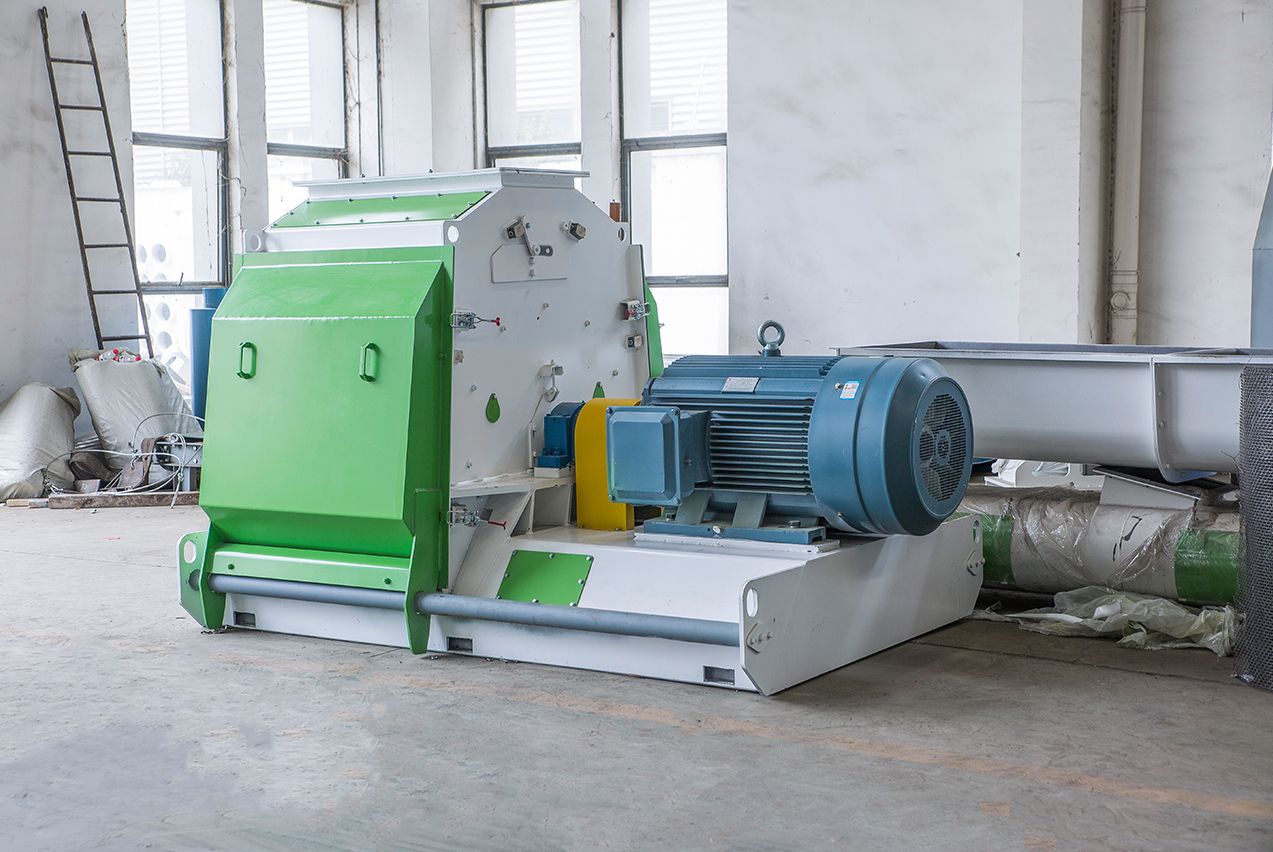
Industrial Biomass Hammer Mills: FSP80T–FSP140T Series
FSP-Series Biomass Hammer Mills: Purpose-Built for Industrial Pre-Processing
Kingwood’s FSP80T, FSP100T, FSP120T, and FSP140T hammer mills are industrial size-reduction machines designed specifically as the first processing stage in biomass pellet production lines. Each model is defined by its knife count — 84, 108, 132, and 144 respectively — which determines throughput capacity and the range of feedstocks the machine can handle economically.
These units process coarse, heterogeneous biomass inputs: branches, bark, plant roots, timber offcuts, straw, and mixed agricultural residues. The output is a uniformly sized particle fraction ready for drum drying and fine grinding before the material enters the pellet mill. Particle uniformity at this stage has a direct downstream effect on pellet density, die wear rate, and final fuel quality.
Kingwood has been designing and manufacturing biomass processing equipment since 1999 — 27 years of continuous R&D — and the FSP series reflects that accumulated engineering knowledge. The machines are CE-marked and manufactured under ISO 9001-certified processes at the company’s 25,000 m² production facility in Liyang Zhongguancun Industrial Park, Jiangsu Province.
Technical Configuration and Feedstock Compatibility
The four FSP models follow a scalable design logic. As knife count increases from 84 to 144, cutting surface area grows proportionally, enabling the larger models to handle higher feed rates and denser materials without loss of particle size consistency. Buyers specify knife count based on three primary variables: target throughput, primary feedstock density, and the downstream pellet mill capacity they need to feed.
Feedstock compatibility across the FSP range includes:
- Wood-based materials: Branches, bark, timber offcuts, wood blocks — common inputs for industrial wood pellet production
- Agricultural residues: Straw, corn stover, sugarcane bagasse, rice husks — materials with variable moisture and fiber structure
- Mixed biomass: Plant roots and coarse fibrous materials that are unsuitable for direct grinding without prior size reduction
The machines are built for continuous-duty industrial operation. Maintenance access is engineered to minimise downtime: knife replacement and rotor inspection do not require full machine disassembly, which is a material consideration in high-utilisation production environments.
Integration Within Kingwood’s Wet-Feed Pellet Production Lines
The FSP hammer mills are designed to function as the entry stage in Kingwood’s complete wet-feed biomass pellet production lines. These lines are engineered to process high-moisture biomass through a defined sequence: crushing → coarse grinding → drying → fine grinding → pelletizing → cooling → packaging. The full sequence is enclosed, dust-controlled, and automated — consistent with Kingwood’s Three-Standardization Framework of Integrated, Dust-Free, and Automated production lines.
After the hammer mill reduces coarse feedstock to the appropriate particle fraction, material moves to a drum dryer that reduces moisture content to below 15% — the threshold required for efficient pelletizing and compliant with EU moisture standards for biomass fuel. Fine-ground, dried material then feeds into a ring die pellet mill. Depending on line capacity requirements, this may be a vertical model such as the JWZL-928 (4–5 tph) or JWZL-688D (3–3.5 tph), or the horizontal JZWH-860 for equivalent capacity with a different process geometry. Complete lines can be designed up to 200,000 metric tons per year output.
The sizing relationship between hammer mill and pellet mill matters operationally. A correctly specified FSP unit ensures that the pellet mill die receives material within the particle size window that maximises throughput and minimises premature die wear — directly affecting the economics of pellet production. Kingwood’s engineering team specifies this relationship during line design, drawing on experience across more than 2,000 production line projects planned and designed since the company’s founding.
Supply Scope: Standalone Units and Complete Line Procurement
Kingwood supplies the FSP-series hammer mills under two procurement models. Industrial buyers expanding existing facilities may source a standalone FSP unit to replace or supplement existing size-reduction equipment. Buyers constructing new pellet production facilities typically specify the hammer mill as part of a complete line, where Kingwood handles process engineering, equipment supply, and integration.
Both supply models benefit from Kingwood’s status as a NEEQ-listed manufacturer (stock code: 871765) — a level of corporate transparency that is material for B2B procurement decisions involving capital equipment. The company holds ISO 9001, ISO 14001, and CE certifications, and is recognised as a Jiangsu Provincial High-Tech Enterprise.
Documented case references for Kingwood-supplied production lines include a 24 tph wood chip pellet line in Vietnam (2023), a 12 tph line in Vietnam that achieved full investment payback within 23 months (2024), and a 30 tph installation in Chongqing, China (2021). Kingwood’s equipment operates in 30 countries across Asia, Europe, and beyond.
For technical specifications, knife configuration guidance, or complete line scoping, contact Kingwood’s industrial sales team directly.
FAQ
What materials can Kingwood's FSP-series hammer mills process?
The FSP80T through FSP140T models are engineered to handle a broad range of coarse biomass feedstocks including branches, bark, plant roots, wood blocks, straw, and agricultural residues. The knife count — 84, 108, 132, or 144 depending on model — allows the machine to be configured for different material hardness and throughput requirements.
How does knife count differ across the FSP model range?
The FSP80T carries 84 knives, the FSP100T carries 108, the FSP120T carries 132, and the FSP140T carries 144. Higher knife counts increase cutting surface area and are suited to denser or higher-volume feedstocks where uniform particle sizing is critical before pelletizing.
How does the hammer mill integrate with downstream pellet mill equipment?
The hammer mill functions as the primary size-reduction stage in Kingwood's wet-feed biomass pellet production lines. After crushing, material is conveyed through drying and fine grinding stages before entering the ring die pellet mill — either a vertical model such as the JWZL-688D or JWZL-928, or the horizontal JZWH-860. Consistent particle sizing from the hammer mill directly determines pellet density and die service life.
Can Kingwood supply the hammer mill as a standalone unit or only as part of a complete line?
Kingwood supplies the FSP-series hammer mills both as standalone units and as integrated components within complete wet-feed pellet production lines scaled up to 200,000 metric tons per year. Buyers requiring only size-reduction equipment can configure and order a single machine; those building new facilities typically specify the hammer mill within a full line design.
What certifications apply to Kingwood's hammer mill equipment?
Kingwood's manufacturing operations hold ISO 9001 and ISO 14001 certifications alongside CE marking. The company is also recognised as a Jiangsu Provincial High-Tech Enterprise and a Jiangsu Provincial Specialized & Innovative Niche Leader, and is listed on the NEEQ stock exchange under code 871765.
What particle output size does the hammer mill produce, and why does it matter for pellet quality?
The hammer mill reduces coarse biomass feedstock to a particle size suitable for subsequent drying and fine grinding. Uniform particle output minimises segregation in the dryer and ensures consistent bulk density entering the pellet mill die — a key factor in producing biomass pellets that meet calorific value targets of 4,800 kcal/kg and moisture content below 15%.
Which countries and project scales has Kingwood supplied biomass pre-processing equipment to?
Kingwood has delivered equipment and complete production line projects to customers across 30 countries. Documented installations include a 24 tph wood chip pellet line in Vietnam (2023), a 12 tph line in Vietnam achieving payback in 23 months (2024), and a 30 tph installation in Chongqing, China (2021). The company has planned and designed over 2,000 production line projects since 1999.
Interested in the Industrial Biomass Hammer Mills: FSP80T–FSP140T Series?
Tell us your throughput, feedstock, and country — sizing + turnkey quote within 24 hours.