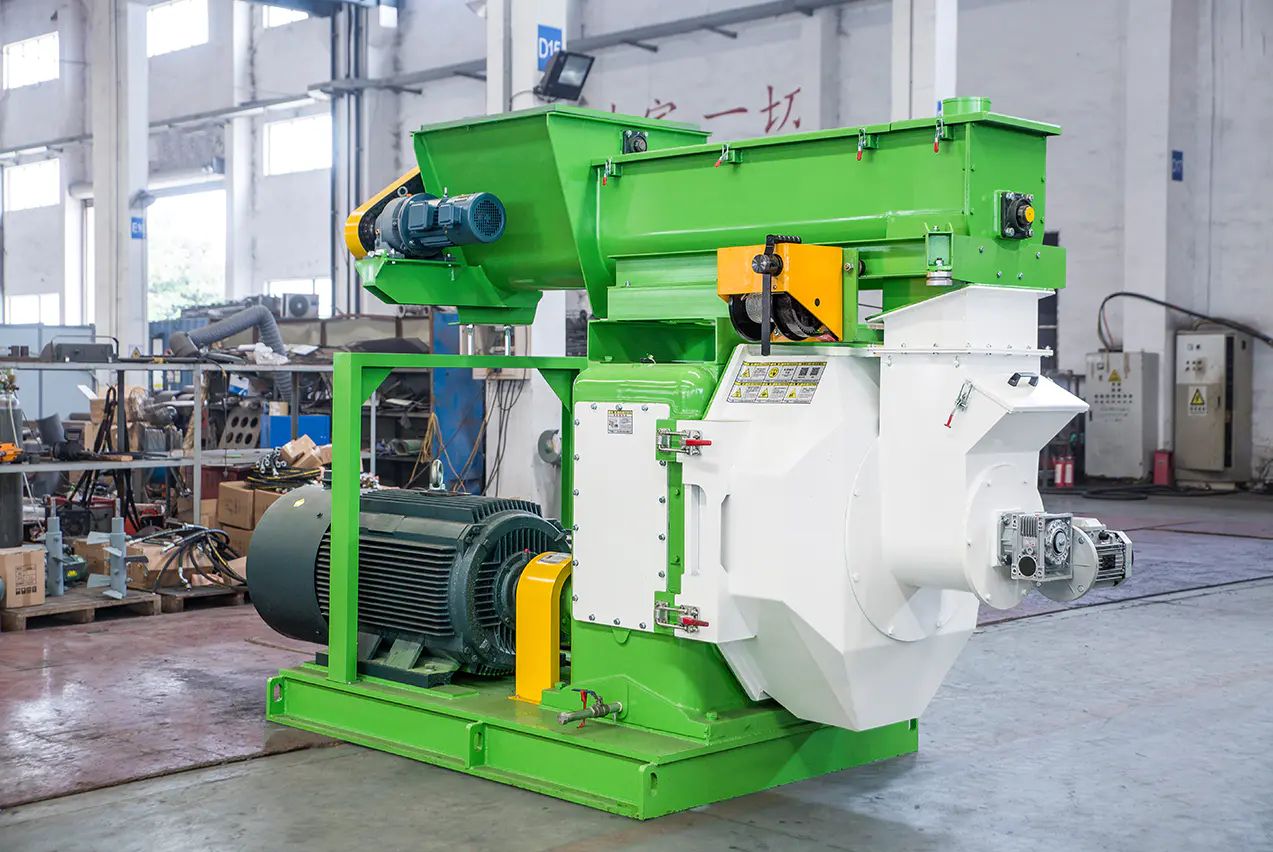
Flat Die Pellet Mill: Benefits for Biomass Production Lines
Kingwood · May 26, 2026
The flat die pellet mill is a practical entry point into biomass pellet manufacturing, particularly for operations processing sawdust, agricultural residues, and mixed woody biomass at small-to-medium throughput levels. Understanding where this machine fits within a full production line—and what separates a well-engineered unit from a low-grade alternative—is essential for any B2B buyer evaluating China-based suppliers.
How a Flat Die Pellet Mill Works and Where It Fits
A flat die pellet mill operates by pressing feedstock downward through a stationary horizontal die plate using compression rollers. As material passes through the die holes under high pressure, it forms into cylindrical pellets cut to length by a discharge-side knife.
This compression method suits fibrous or low-density biomass—sawdust, straw, rice husks—that require controlled pressure rather than the centrifugal force used in ring die configurations. The flat die design is mechanically simpler than a ring die pellet mill, which reduces maintenance complexity and makes it better suited to intermittent or variable-volume production runs.
For industrial-scale continuous production above 2 tonnes per hour, a ring die configuration integrated into a full wet-feed production line is the more appropriate architecture. Kingwood’s vertical ring die models—including the JWZL-688 (2–2.3 TPH), JWZL-928 (4–5 TPH), and the horizontal JZWH-860 (4–5 TPH)—are engineered for exactly this type of high-throughput, automated operation.
Key Production Benefits for Industrial Operators
Feedstock Flexibility A flat die pellet mill handles sawdust, wood chips, rice husks, corn stalks, and other lignocellulosic materials without major mechanical reconfiguration. For producers working with seasonally variable or mixed biomass inputs, this multi-feedstock capability reduces procurement risk and allows production schedules to adapt to available raw material supply.
Consistent Pellet Geometry The flat die compression mechanism delivers uniform pellet diameter and density across a production run. Consistency in pellet geometry directly affects combustion performance in pellet stoves and industrial boilers—irregular density causes uneven burn rates, higher ash output, and reduced heat yield. Properly calibrated flat die equipment produces pellets meeting a calorific value of 4,800 kcal/kg, moisture content below 15%, and sulfur content below 0.3%, benchmarks aligned with EU and ISO quality standards.
Lower Entry-Level Capital Cost Flat die pellet mills carry a lower upfront capital cost than ring die systems, making them accessible for producers establishing new operations or running pilot-scale lines before scaling. The trade-off is throughput ceiling: flat die machines are typically practical up to approximately 1–2 TPH, whereas ring die lines scale from 2 TPH to 30+ TPH in integrated plant configurations.
Reduced Secondary Processing Uniform compression reduces the proportion of fines and undersized pellets requiring reprocessing. This directly lowers energy consumption per tonne of finished product and simplifies downstream handling in packaging and storage operations.
Evaluating a China Flat Die Pellet Mill Supplier
Supplier credibility and post-sale support are as critical as mechanical specifications. The following criteria provide a structured evaluation framework.
Certifications: Verify ISO 9001 quality management and ISO 14001 environmental management certification at minimum. CE marking is mandatory for equipment shipped to European markets. Suppliers listed on China’s NEEQ are subject to disclosure requirements that provide additional financial transparency—Kingwood trades under stock code 871765.
Spare Parts and Technical Support: Wear components—particularly the die plate and compression rollers—require periodic replacement. Confirm that the supplier maintains a documented spare parts inventory and can provide remote or on-site technical support. Lead times for critical components should be established in the supply agreement before purchase.
Production Line Integration Capability: A flat die pellet mill is one component within a broader process that typically includes size reduction (hammer mill or drum chipper), drying (drum dryer), pelletizing, cooling (counter-flow cooler), and packaging. Suppliers capable of designing and commissioning complete integrated lines reduce coordination risk and provide single-source accountability.
Kingwood has planned and designed over 2,000 production line projects across 30 countries, including complete wet-feed biomass pellet lines with annual capacities up to 200,000 metric tons. The company’s Vietnam 12 TPH installation achieved full capital payback within 23 months—a concrete benchmark for the financial viability of properly engineered biomass pellet operations.
Emissions Performance and Regulatory Compliance
Pellets produced from sawdust and similar clean biomass feedstocks deliver measurable emissions advantages over coal and heavy fuel oil. When combustion equipment is properly matched to pellet quality specifications, all emission indicators can meet or exceed China’s GB13271-2001 national boiler air pollutant emission standard. Dioxin content in compliant biomass pellets measures below 0.5 ng TEQ/m³—well within China’s national standard of ≤1.0 ng TEQ/m³. Ash content below 18% and sulfur content below 0.3% further support compliance with international boiler operation requirements across the EU, Japan, and North American markets.
For operators supplying pellets to industrial boiler customers or power co-firing facilities, the ability to document emission compliance is increasingly a commercial requirement, not only a regulatory one. Sourcing equipment from a manufacturer holding verifiable quality certifications—ISO 9001, ISO 14001, CE—supports this documentation chain directly.
Producers ready to evaluate ring die configurations at higher throughput levels can reference Kingwood’s complete biomass pellet production line engineering consultation as a practical next step.
FAQ
What raw materials can a flat die pellet mill process?
A flat die pellet mill can process sawdust, wood chips, agricultural residues such as straw and rice husks, and other lignocellulosic biomass. This multi-feedstock capability suits producers handling variable or mixed biomass inputs without reconfiguring the entire production line.
How does a flat die pellet mill differ from a ring die pellet mill in industrial applications?
A flat die pellet mill uses a horizontal die plate with rollers that press material downward through die holes, making it well-suited for lower-to-mid capacity operations and fibrous materials. A ring die pellet mill—such as Kingwood's JWZL or JZWH-860 series—uses a rotating cylindrical die optimized for high-throughput industrial lines typically running 2 to 30+ tonnes per hour, where continuous output and automation are priorities.
What pellet quality standards should a China-sourced flat die pellet mill meet?
Pellets produced for export should meet moisture content below 15% (EU standard), sulfur content below 0.3%, ash content below 18%, and a calorific value of at least 4,800 kcal/kg. Equipment from certified manufacturers should comply with ISO 9001 quality management standards to ensure consistent output.
Is a flat die pellet mill suitable for large-scale commercial biomass fuel production?
Flat die pellet mills are best suited for small-to-medium production scales. For commercial operations requiring 2 to 30+ tonnes per hour, a ring die pellet mill integrated into a complete wet-feed production line—covering crushing, drying, pelletizing, and packaging—is the recommended configuration. Kingwood designs complete lines with annual capacities up to 200,000 metric tons.
What maintenance considerations apply to a flat die pellet mill?
Key wear components include the flat die plate and compression rollers, which require periodic inspection and replacement depending on feedstock abrasiveness. Choosing a machine with accessible component layouts reduces downtime. Sourcing from a manufacturer with verified spare parts availability and technical support is critical for minimizing operational interruptions.
How does biomass pellet fuel compare to fossil fuels in terms of operating cost?
Biomass pellets produced via flat die or ring die pellet mills can reduce fuel costs by 40–50% compared to conventional fossil fuels, based on Kingwood's operational data across deployed production lines. This cost advantage, combined with lower sulfur and dioxin emissions, supports both economic and regulatory compliance goals.
What certifications should I verify when sourcing a flat die pellet mill from a Chinese supplier?
Verify at minimum: ISO 9001 (quality management), ISO 14001 (environmental management), and CE marking for export-destined equipment. Additional indicators of supplier credibility include NEEQ stock listing (Kingwood: 871765), provincial high-tech enterprise status, and membership in recognized industry bodies such as the China Biomass Energy Industry Alliance.
- Global biomass pellet production capacity exceeded 50 million metric tons annually as of 2023, driven by industrial heating and power co-firing demand across Europe and Asia. (2023, IEA Bioenergy Task 40 — Sustainable International Bioenergy Trade)
- Biomass pellets can reduce fuel operating costs by 40–50% compared to fossil fuel alternatives, based on Kingwood-deployed production line performance data. (2024, Kingwood operational case data, Vietnam 12 TPH line (23-month payback))