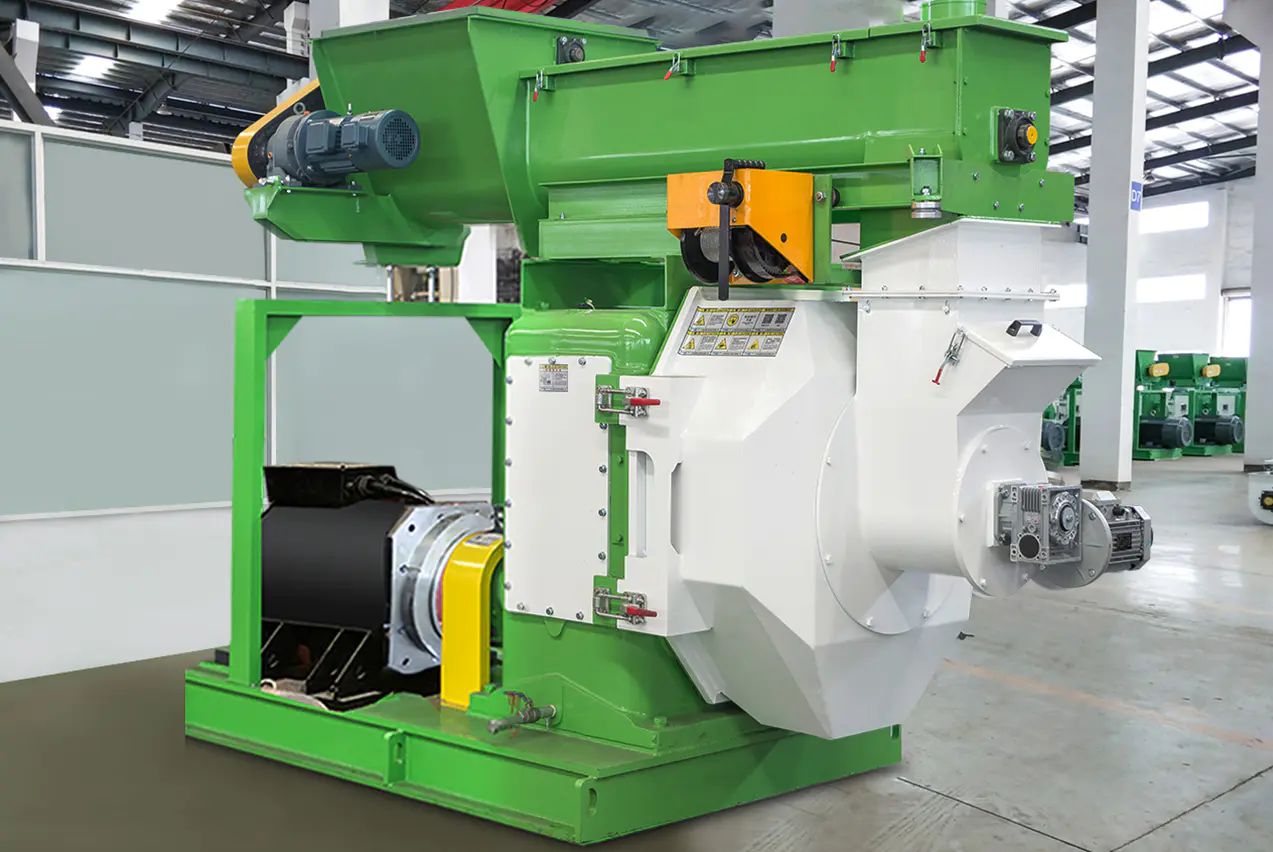
Industrial Biomass Wood Pellet Mill Machine — JWZL-688D
Capacity: 3–3.5 t/h
JWZL-688D: Vertical Ring Die Pellet Mill for Industrial Biomass Production
The Kingwood JWZL-688D is a 3–3.5 t/h vertical biomass pellet mill engineered for continuous commercial-scale operation. Its vertical ring die configuration distributes mechanical stress more evenly across the die surface than horizontal alternatives, extending component service life and maintaining pellet density consistency across extended production runs.
The ring die is the machine’s core precision component. Kingwood manufactures dies to tight dimensional tolerances, with bore geometry and compression ratio matched to feedstock bulk density, moisture profile, and target pellet diameter. Press rollers are hardened for high-load durability and positioned to ensure uniform nip pressure across the die face. An automatic lubrication circuit delivers grease continuously to bearing assemblies, reducing manual maintenance intervals and protecting against premature wear under heavy-duty cycling.
The JWZL-688D is driven by a high-efficiency motor selected to minimize specific energy consumption per ton of output. The vertical die geometry enables gravity-assisted die filling and reduces recirculation losses, delivering competitive throughput at lower operating cost relative to equivalent-capacity horizontal designs.
Integration into Complete Wet-Feed Biomass Pellet Production Lines
The JWZL-688D is designed for integration, not standalone deployment. Its full performance is realized within Kingwood’s complete wet-feed pellet production lines, which handle high-moisture raw biomass from intake through to finished packaged product. A standard configuration sequences the following unit operations:
- Coarse size reduction — drum chipper or hammer mill reduces oversized woody biomass to workable chip dimensions
- Primary grinding — hammer mill conditions chips to a consistent particle size distribution for dryer feed
- Thermal drying — drum dryer reduces feedstock moisture from field-received levels to the sub-15% target required for pelletization
- Fine grinding — secondary hammer mill stage conditions dried material for die entry
- Pelletizing — JWZL-688D ring die mill forms uniform pellets at 3–3.5 t/h
- Cooling — counter-flow cooler brings pellets to ambient temperature, hardening the surface and reducing breakage during handling
- Packaging and dispatch — automated pellet packaging machine completes the line
The entire sequence runs enclosed, with integrated dust removal at each transfer point. This architecture directly implements Kingwood’s Three-Standardization Framework — integrated, dust-free, and automated production lines — the engineering standard applied across all Kingwood line designs. Complete lines are scalable to production capacities up to 200,000 metric tons per year.
For a live example of this system at industrial scale, see the 24 t/h wood chip pellet production line delivered to Vietnam in 2023.
Pellet Fuel Specifications and Industrial End-Use Applications
Pellets produced on JWZL-688D-based lines meet the following verified fuel specifications:
| Parameter | Kingwood Output | Reference Standard |
|---|---|---|
| Calorific value | 4,800 kcal/kg | US standard: >2,500 kcal/kg |
| Moisture content | <15% | EU standard: <15% |
| Sulfur content | <0.3% | Japan standard: ≤0.5% |
| Ash content | <18% | ISO standard: <20% |
| Dioxin emissions | <0.5 ng TEQ | China GB: ≤1.0 ng TEQ |
All combustion emission indicators comply with GB13271-2001, China’s national Emission Standard of Air Pollutants for Boilers. These parameters position Kingwood-produced biomass pellets for acceptance across industrial end-use markets globally.
Primary industrial applications include:
- Co-firing in coal displacement programs — biomass pellets are co-fired with coal in utility boilers, reducing carbon intensity without full boiler conversion investment
- Industrial process heat — pellets replace heavy fuel oil or natural gas in industrial furnaces, kilns, and process steam systems; operating cost reductions of 40–50% versus fossil fuel equivalents are achievable under current market conditions
- District heating networks — pellets serve as primary fuel in centralized biomass heating plants in cold-climate markets
- Agricultural and food processing — drying operations, greenhouse heating, and feed processing facilities operate on pellet-fired thermal systems
OEM Manufacturing Capability and Global Supply Track Record
Jiangsu Kingwood Industrial Co., Ltd. — formerly Jiangsu Kingwood Machinery Co., Ltd. — has operated since 1999, accumulating 27 years of focused R&D in biomass pellet equipment. The company is headquartered at #568 Hongsheng Road, Liyang Zhongguancun Industrial Park, Liyang City, Jiangsu Province, with 25,000 m² of production floor space and 6,200 m² of engineering and office facilities.
Kingwood is listed on China’s NEEQ exchange under stock code 871765 and holds ISO 9001, ISO 14001, and CE certification across its product range. A dedicated team of 20 R&D specialists supports OEM configuration, application-specific die selection, and full production line engineering.
To date, Kingwood has designed and planned over 2,000 pellet production line projects across 30 countries, with aggregate annual biomass fuel production capacity exceeding 10 million metric tons. OEM customers receive engineering documentation, spare parts programs, and commissioning support as standard scope.
Buyers specifying commercial-scale biomass pellet equipment should evaluate the JWZL-688D against the full Kingwood vertical mill range — from the JWZL-420 at 1–1.5 t/h through the JWZL-928 at 4–5 t/h — or contact Kingwood technical sales for a site-specific production line proposal.
FAQ
What is the output capacity of the JWZL-688D biomass pellet mill?
The JWZL-688D produces 3–3.5 metric tons per hour of biomass pellets under standard operating conditions.
What biomass feedstocks can the JWZL-688D process?
The JWZL-688D handles a wide range of biomass materials including wood chips, sawdust, agricultural residues, and other lignocellulosic feedstocks with varying moisture levels when integrated into a wet-feed production line.
Is the JWZL-688D available for OEM or custom configuration?
Yes. Jiangsu Kingwood Industrial Co., Ltd. provides OEM manufacturing and custom engineering for the JWZL-688D, including motor configuration, die specifications, and full production line integration.
What certifications does Kingwood hold for its pellet mill equipment?
Kingwood holds ISO 9001, ISO 14001, and CE certifications, and is recognized as a Jiangsu Provincial High-Tech Enterprise. The company is listed on the NEEQ stock exchange under code 871765.
How does the JWZL-688D fit into a complete pellet production line?
The JWZL-688D integrates into Kingwood's complete wet-feed pellet production lines, which include hammer mill pre-processing, drum drying, fine grinding, pelletizing, counter-flow cooling, and automated packaging — all within an enclosed, dust-free environment.
What pellet fuel quality standards do Kingwood production lines meet?
Biomass pellets produced on Kingwood lines achieve a calorific value of 4,800 kcal/kg, moisture content below 15%, sulfur content below 0.3%, and dioxin emissions below 0.5 ng TEQ — meeting EU, US, Japanese, and Chinese GB national standards.
What is Kingwood's Three-Standardization Framework?
The Three-Standardization Framework is Kingwood's proprietary design philosophy covering integrated, dust-free, and automated production lines. It is the core differentiator applied across all Kingwood equipment and complete line projects.