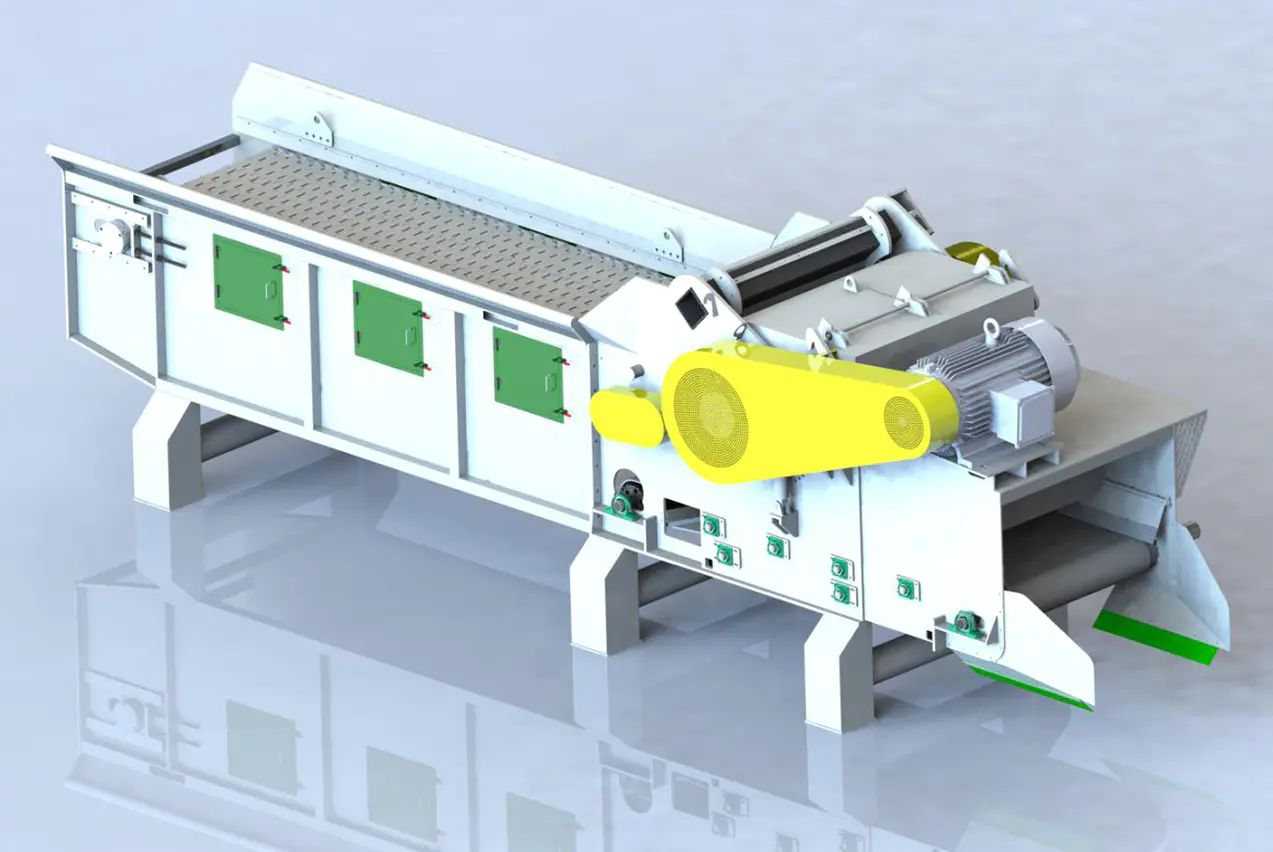
Industrial Hammer Mill & Belt Conveyor Systems by Kingwood
Hammer Mill Design for Biomass Size Reduction
In a biomass pellet production line, the hammer mill performs the first critical size-reduction stage. Raw feedstock — wood chips, agricultural straw, crop husks — arrives at varying particle sizes and moisture contents. The hammer mill reduces this material to a uniform particle size range, typically under 5mm, before it enters drying and fine-grinding stages.
Kingwood’s hammer mill is built around a thickened 16mm screen — a specification that sets it apart from lighter-duty designs common in general agricultural grinding applications. This reinforced screen geometry serves two functions: it sustains structural integrity under the continuous impact load of high-speed rotating hammers, and it maintains dimensional accuracy over extended operating cycles, delivering consistent particle size output without frequent screen replacement.
The rotor assembly uses hardened hammer heads mounted on a high-inertia rotor shaft. High peripheral velocity delivers the impact energy required to fracture lignocellulosic material efficiently, while the screen controls final particle size regardless of feedstock variation. This combination — robust screen construction plus controlled impact geometry — makes the machine suitable as a front-end unit in high-throughput biomass pellet lines rather than intermittent batch operations.
Belt Conveyor and Crusher Conveyor Integration
Material handling between process stages is where many biomass production lines lose efficiency — through transfer spillage, fugitive dust, and bottlenecking at manual transfer points. Kingwood addresses this with enclosed belt conveyor and crusher conveyor systems designed to interconnect with the hammer mill outlet and downstream drying or pelletizing equipment.
The belt conveyor operates as a continuous feed mechanism, eliminating throughput variability associated with batch or pneumatic transfer alternatives. Key engineering considerations in Kingwood’s conveyor design include:
- Belt width and speed matched to hammer mill output volume to prevent choke points
- Enclosed conveyor housing aligned with the dust-free production line standard — one of the three pillars of Kingwood’s Three-Standardization Framework
- Modular frame sections enabling straight-run or inclined configurations to suit different facility layouts
- Drive unit sizing calibrated for the bulk density of processed biomass, which varies substantially between wood chip and agricultural residue feedstocks
The crusher conveyor — the transfer belt receiving material directly from the hammer mill discharge — is built to handle abrasive, high-volume flow at this stage. Reinforced belt material and sealed transfer chutes reduce wear and contain fine particles within the process envelope, consistent with Kingwood’s dust-free workshop design standard.
Complete Wet-Feed Production Line Context
Kingwood’s hammer mill and conveyor systems are engineered components within a complete wet-feed biomass pellet production line architecture — not standalone products. A full Kingwood line processes high-moisture biomass through the following sequential stages: drum chipping → coarse grinding (hammer mill) → drum drying → fine grinding → ring die pelletizing → counter-flow cooling → packaging.
This end-to-end integration approach, with all equipment specified by a single manufacturer, eliminates compatibility issues that arise when combining equipment from multiple suppliers. Throughput rates, belt speeds, motor sizing, and control logic are coordinated across the line from initial engineering.
For high-output projects, Kingwood’s complete lines scale to 200,000 metric tons per year per installation. The company has planned and designed more than 2,000 production line projects for clients across 30 countries, with documented installations in Vietnam, China, and beyond. The 24 t/h wood chip pellet line in Vietnam (2023) illustrates how the hammer mill and conveyor stages function within a large-scale integrated project.
Kingwood (Jiangsu Kingwood Industrial Co., Ltd.) holds ISO 9001, ISO 14001, and CE certifications and is publicly listed on the NEEQ under stock code 871765. The company’s 25,000 m² production facility is located at #568 Hongsheng Road, Liyang Zhongguancun Industrial Park, Jiangsu Province, China. For throughput requirements, custom conveyor layouts, or spare parts inquiries, contact Kingwood’s engineering sales team directly.
FAQ
What is the screen thickness used in Kingwood's hammer mill, and why does it matter?
Kingwood's hammer mill equips a thickened 16mm screen. This reinforced screen thickness directly extends service life under high-cycle biomass processing loads, reduces screen deformation at peak throughput, and ensures consistent particle size output for downstream pelletizing stages.
Can the hammer mill and belt conveyor be integrated into an existing biomass pellet production line?
Yes. Kingwood designs its hammer mills and belt conveyors with modular, standardized interfaces to retrofit into or expand existing biomass processing lines. The equipment connects to upstream chipping or coarse grinding stages and feeds directly into drying and pelletizing units. Kingwood's engineering team provides layout consultation based on your facility footprint and target throughput.
What materials can Kingwood's hammer mill process?
Kingwood's hammer mills are designed for biomass feedstocks including wood chips, agricultural residues such as straw and husks, and other lignocellulosic materials. The machine reduces bulk input to the particle size range required for efficient ring die pelletization — typically under 5mm for standard biomass pellet production.
How does the belt conveyor system reduce material loss in a production line?
The enclosed belt conveyor design minimizes open transfer points where fine biomass particles would otherwise scatter or become airborne. Combined with Kingwood's dust-free production line standard — one of the three pillars of the Three-Standardization Framework — the conveyor system contains material within the process envelope, reducing both product loss and fugitive dust emissions in the workshop.
What certifications apply to Kingwood's hammer mill and conveyor equipment?
Kingwood holds ISO 9001, ISO 14001, and CE certifications covering its equipment range. The company is also recognized as a Jiangsu Provincial High-Tech Enterprise and a Jiangsu Provincial Specialized & Innovative Niche Leader. CE certification confirms compliance with European machinery safety and electromagnetic compatibility directives.
What production line capacity can Kingwood's hammer mill and conveyor systems support?
Kingwood's complete wet-feed biomass pellet production lines scale up to 200,000 metric tons per year. Within those lines, hammer mill and conveyor equipment is specified to match installed pellet mill throughput — from 1 t/h on JWZL-420 lines up to 4–5 t/h on JWZL-928 or JZWH-860 configurations, with multi-unit arrangements on larger industrial projects.
Does Kingwood provide after-sales support and spare parts for hammer mills and conveyors?
Kingwood has served customers across 30 countries and maintains engineering support for planned and installed production lines. Spare parts — including replacement screens, hammers, and conveyor belting — are covered under the standard service agreement. Contact Kingwood's sales team directly to confirm lead times and parts stocking for your specific equipment configuration.