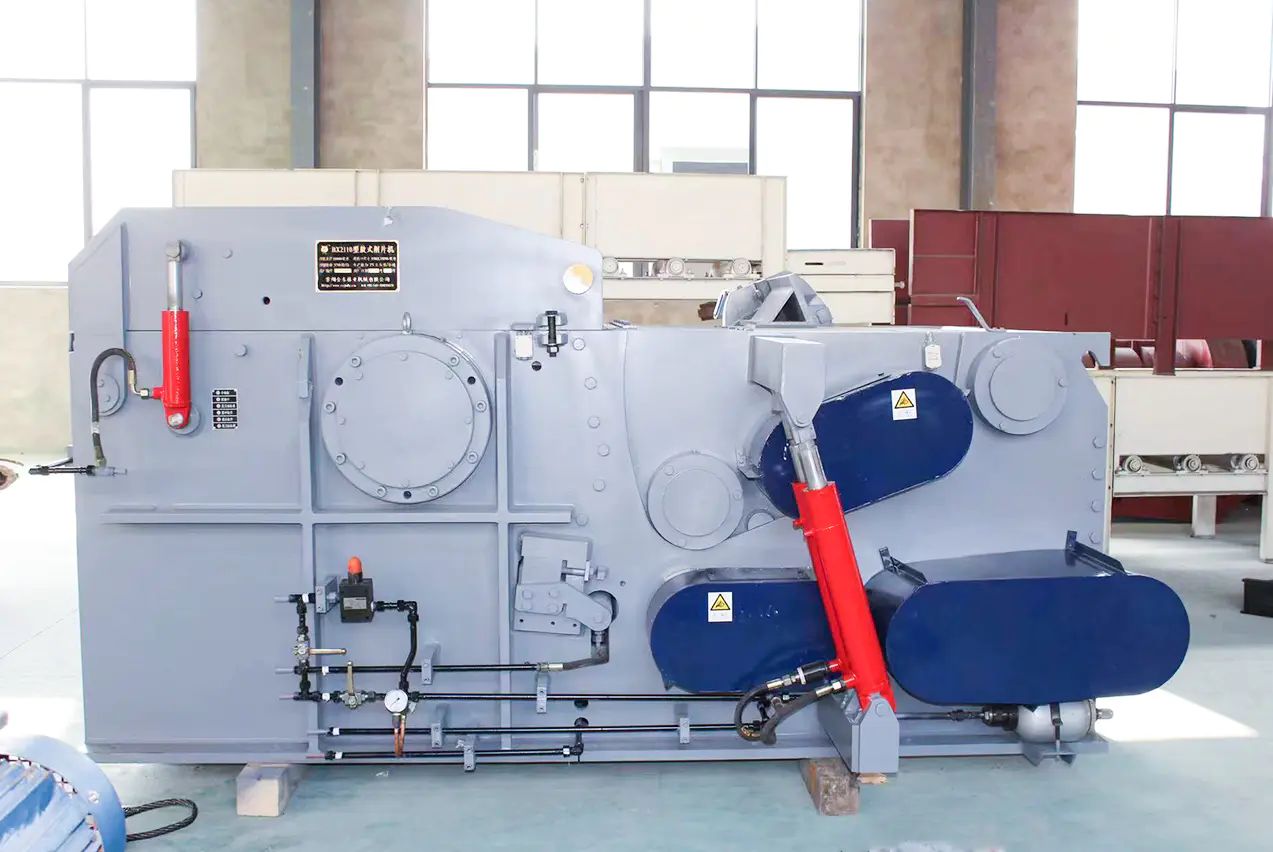
Industrial Drum Chipper for Biomass Pellet Production Lines
Why the Drum Chipper Is the Critical First Stage in Biomass Pellet Lines
Wood size reduction is where raw material variability is highest — and where process control matters most. Logs, forestry harvest residues, sawmill offcuts, and bark arrive at different moisture levels, bulk densities, and geometries. A drum chipper that cannot handle this variability reliably will propagate inconsistency downstream: increasing hammer mill wear, disrupting dryer residence time, and degrading pellet density and durability at the pellet mill die.
Kingwood’s industrial drum chipper is engineered for this upstream duty. Its cutting geometry is configured to produce chips of consistent length and cross-section regardless of infeed irregularity, delivering a homogenous particle stream to the downstream hammer mill. Raw material compatibility covers the full range of wood-origin feedstocks — undersized round logs, tree tops and branches from forestry operations, slabs and edgings from primary sawmilling, and mixed residues from furniture or panel board manufacturing. Both softwood and hardwood species at green (undried) moisture content are accepted without pre-conditioning.
Chip geometry is not an incidental specification. Oversized or irregular chips create uneven pressure distribution at the pellet mill ring die, accelerating die wear and producing pellets with surface cracking and low durability. Consistent chip dimensions from the chipping stage reduce total specific energy consumption across the entire line and extend die service life — both of which have a direct effect on cost per metric ton of finished pellet.
Integration with Kingwood’s Wet-Feed Pellet Production Line Architecture
Kingwood’s complete biomass pellet production lines operate on a wet-feed architecture: the line accepts high-moisture raw biomass and processes it through sequential enclosed stages without requiring pre-drying before size reduction. This eliminates the fire and dust hazard associated with grinding dry material at the front end, and allows operators to feed freshly harvested residues directly from the yard into the process.
The standard wet-feed process sequence is:
- Drum chipping — bulk size reduction of raw wood to coarse chips
- Coarse grinding — hammer mill reduces chips to a screened particle fraction
- Drum drying — moisture reduced to below 15%, meeting both pelletizing and fuel specifications
- Fine grinding — second hammer mill pass to achieve pellet mill infeed particle size
- Pelletizing — ring die pellet mill (JWZL or JZWH series) at 1–5+ t/h per unit depending on model
- Cooling — counter-flow cooler stabilizes pellet structure and reduces temperature
- Packaging — automated bagging for bulk or retail dispatch
This integrated sequence is the operational foundation of Kingwood’s Three-Standardization Framework, which combines Integrated production lines, Dust-Free enclosed processing, and Automated control into a single cohesive system. The drum chipper’s output quality directly determines the efficiency of every downstream stage — which is why chipper specification is determined through system-level design rather than as an independent equipment procurement.
For documented scale reference, Kingwood engineered a 30 t/h wood pellet production line in Chongqing, China in 2021, where the front-end chipping and grinding capacity was precisely matched to sustain continuous pellet mill throughput at that aggregate rate. A further reference in export markets is the 12 t/h Vietnam wood pellet line, which achieved full investment payback in 23 months — a documented benchmark for line economics including front-end chipping, drying, and pelletizing at commercial scale.
Specifying a Drum Chipper: Key Variables and System Matching
Drum chipper selection for a biomass pellet project is determined by four primary variables: target line throughput in t/h, raw material bulk density and moisture content, maximum infeed log or residue dimension, and the downstream hammer mill infeed specification. Mismatching any one of these parameters introduces a throughput bottleneck or increases operating cost per metric ton of finished pellet.
Kingwood’s engineering team conducts a system-level capacity analysis before specifying chipper model and configuration. Complete production lines are designed for annual capacities up to 200,000 metric tons, with modular configurations available for smaller-scale operations. The JWZL pellet mill series spans from 1–1.5 t/h (JWZL-420) through 2–2.3 t/h (JWZL-688), 3–3.5 t/h (JWZL-688D), and 4–5 t/h (JWZL-928), with the JWZL-1068 available for higher-output applications. The horizontal JZWH-860 operates at 4–5 t/h. Chipping front-end capacity is proportioned to whichever pellet mill configuration is selected to ensure no upstream starvation under continuous automated operation.
All Kingwood equipment is manufactured under ISO 9001 and ISO 14001 certified systems and carries CE marking. Jiangsu Kingwood Industrial Co., Ltd. has 27 years of biomass processing equipment development experience, operates from a 31,200 m² facility at Liyang Zhongguancun Industrial Park, and is listed on China’s NEEQ exchange (stock code: 871765). The company has planned and designed over 2,000 production line projects and serves clients across 30 countries.
To discuss drum chipper specifications, matched system configurations, or B2B wholesale supply terms, contact Kingwood’s technical sales team with your feedstock type, target throughput, and site location.
FAQ
What raw materials can Kingwood's drum chipper process?
The drum chipper handles undersized round logs, forest harvesting residues (branches, tops, bark), and wood processing residues (offcuts, slabs, edgings). Both softwoods and hardwoods at green moisture content are accepted without pre-conditioning, making it a practical front-end unit for wet-feed biomass pellet production lines.
How does the drum chipper integrate into a complete wet-feed pellet production line?
In Kingwood's wet-feed line architecture, the drum chipper is the first size-reduction stage. It reduces bulk raw wood to coarse chips, which then pass through a hammer mill, drum dryer (to below 15% moisture), a second grinding stage, a ring die pellet mill, a counter-flow cooler, and automated packaging. This enclosed sequential process is the operational basis of Kingwood's Three-Standardization Framework — Integrated, Dust-Free, and Automated production.
Why does chip size uniformity matter for pellet mill performance?
Chip geometry directly affects die pressure, pellet density, and energy consumption in the pellet mill. Oversized or irregular chips cause uneven die wear and pellet cracking. Kingwood drum chippers produce chips of consistent length and cross-section suited for hammer mill infeed, ensuring homogeneous particle size before pelletizing and reducing total specific energy consumption across the line.
What throughput capacities are available, and how are they matched to pellet mill output?
Kingwood sizes drum chipper capacity to match the downstream pellet mill throughput. A JWZL-928 pellet mill operating at 4–5 t/h requires a chipping and grinding front end proportioned to sustain that feed rate continuously. For large-scale projects, Kingwood engineers complete lines handling up to 30 t/h aggregate throughput — as deployed in the Chongqing, China installation in 2021. Contact Kingwood sales with your target annual output for a matched system specification.
Is the drum chipper compatible with high-moisture feedstocks?
Yes. Kingwood's wet-feed line architecture is specifically designed for high-moisture biomass. The drum chipper operates upstream of the drum dryer, processing raw undried material. This eliminates the fire risk and energy waste of pre-drying before size reduction and allows freshly harvested residues to feed directly into the line without intermediate conditioning.
What certifications apply to Kingwood drum chippers?
All Kingwood equipment, including drum chippers, is manufactured under ISO 9001 and ISO 14001 certified quality and environmental management systems and carries CE marking for export markets. Kingwood holds Jiangsu Provincial High-Tech Enterprise status and is listed on China's NEEQ exchange (stock code: 871765), subject to ongoing compliance disclosure obligations.
Does Kingwood supply drum chippers as standalone units or only within complete lines?
Kingwood supplies drum chippers both as standalone units for clients upgrading an existing line stage, and as integrated components within complete new biomass pellet production lines. For new investments targeting annual capacities up to 200,000 metric tons, Kingwood recommends a full line assessment to ensure the chipper, dryer, grinder, pellet mill, cooler, and packaging system are properly matched for continuous automated operation.