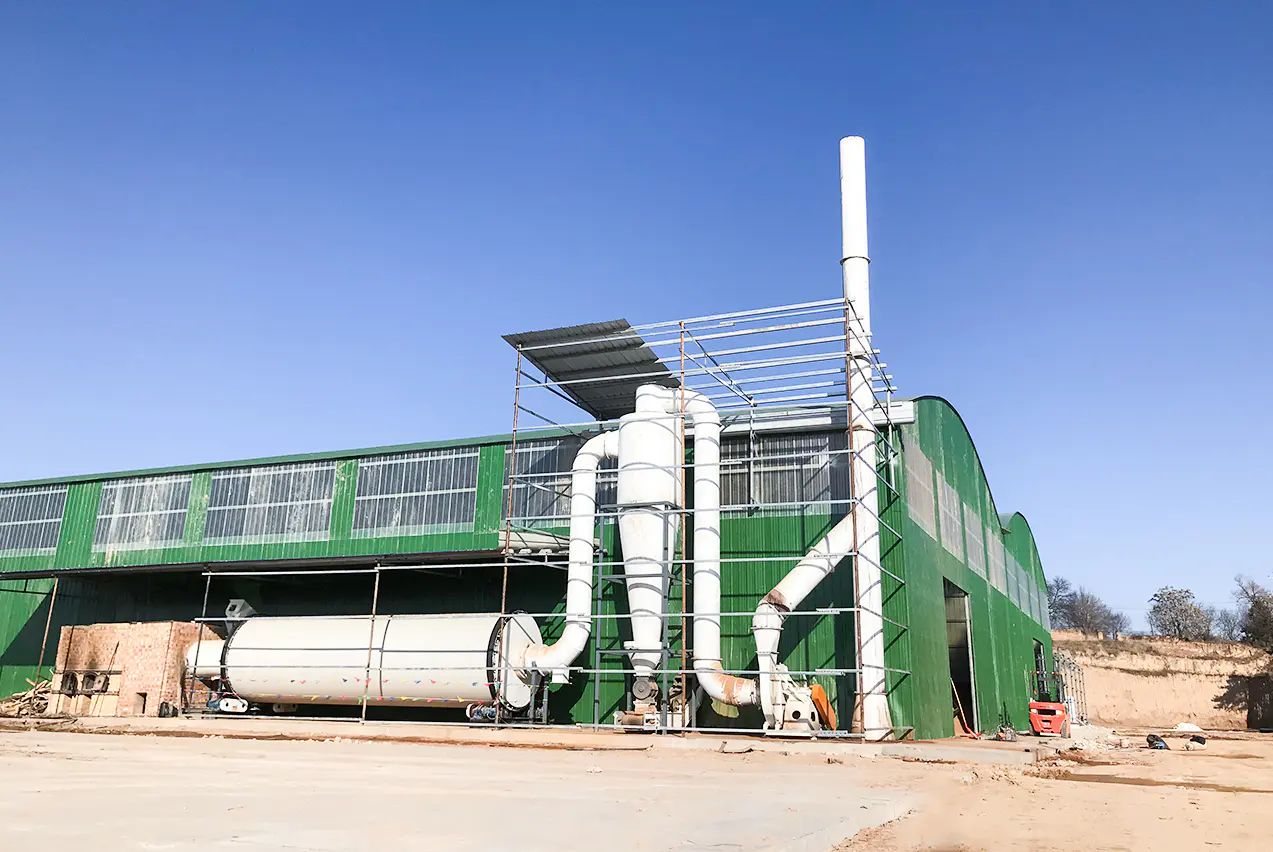
Industrial Biomass Drum Dryer for Pellet Production Lines
Role of the Drum Dryer in Biomass Pellet Production
Moisture control is the single most critical variable in biomass pelletizing. Ring die pellet mills require feedstock moisture consistently below 15% to achieve proper pellet density, mechanical durability, and calorific output. When processing raw wood chips, agricultural residues, or bark—materials that arrive at 35–50% moisture—a dedicated industrial drying stage is not optional; it is the rate-limiting step for the entire line.
Kingwood’s drum dryer occupies this position in the wet-feed pellet production sequence: crushed biomass from the upstream hammer mill or drum chipper is conveyed directly into the rotating drum, where sustained thermal contact reduces free moisture to pelletization-ready levels before the material advances to fine grinding and the pellet mill.
The rotating drum design ensures continuous material tumbling, which achieves three technically important outcomes: uniform heat penetration across particle cross-sections, prevention of localized overheating that degrades lignin binders, and consistent residence time distribution that eliminates under-dried fractions entering the pellet mill die.
Technical Specifications and Line Integration
Kingwood manufactures drum dryers across six capacity configurations—SG10, SG20, SG30, SG40, SG50, and SG60—sized to match complete production lines from small commercial facilities through large export-scale operations reaching 200,000 metric tons per year.
Feedstock compatibility covers the full range of lignocellulosic materials used in industrial pellet production:
- Wood chips and sawdust from sawmill and wood processing operations
- Bark and forestry harvesting residues
- Agricultural crop residues: corn stover, wheat straw, rice husks, sugarcane bagasse
- Energy crops and municipal green waste fractions
Process integration follows Kingwood’s established wet-feed line architecture:
- Raw biomass intake and coarse size reduction (drum chipper)
- Hammer mill grinding to intermediate particle size
- Drum dryer — moisture reduction from 35–50% to target <15%
- Fine grinding stage
- Ring die pellet mill (JWZL or JZWH series)
- Counter-flow cooler and pellet packaging
This sequence operates as a fully automated, enclosed processing loop. Conveyors, sensors, and control systems maintain material flow without manual intervention between stages—a direct requirement of the Integrated and Automated pillars within Kingwood’s Three-Standardization Framework.
For dust management, the drum dryer is designed for installation within Kingwood’s Dust-Free production line configuration. Exhaust air from the drying drum is routed through integrated dust collection before discharge, keeping particulate emissions below the thresholds set in China’s GB13271-2001 Boiler Emission Standard.
Why Drying Performance Directly Affects Pellet Economics
The economics of biomass pellet production are closely tied to moisture uniformity at the pellet mill inlet. Excess moisture causes die blockages, increases specific energy consumption per ton of pellets, and reduces pellet durability index (PDI)—a key quality metric for commercial and export-grade pellets.
Kingwood’s drum dryer specifications are matched to the downstream pellet mill requirements across the product range. For example, the JWZL-928 operating at 4–5 t/h and the JZWH-860 horizontal pellet mill at 4–5 t/h both require consistent feedstock moisture and particle size distribution to sustain rated output. Under-capacity or inconsistent drying is the most common cause of pellet mill throughput losses in the field.
Properly dried biomass pellets meeting Kingwood’s fuel specifications—calorific value of 4,800 kcal/kg, moisture <15%, sulfur <0.3%, ash <18%—deliver 40–50% fuel cost reduction versus coal or heavy fuel oil in industrial boiler applications. Achieving those specifications starts at the drying stage.
For reference on how the complete line performs at commercial scale, see the Vietnam 24 t/h wood chip pellet production line case study, where Kingwood’s integrated equipment set—including drying—sustained rated throughput from commissioning.
Selecting the Right Drum Dryer Configuration
Correct dryer sizing requires three inputs: raw material moisture content, target output moisture, and hourly throughput requirement matched to the downstream pellet mill. Kingwood’s engineering team conducts feedstock assessments and thermal load calculations before recommending a specific SG-series configuration.
Key selection parameters:
| Parameter | Typical Design Range |
|---|---|
| Inlet moisture | 35–50% (wet basis) |
| Outlet moisture | <15% (pelletization standard) |
| Feedstock bulk density | Variable by material type |
| Heat source | Biomass combustion / gas / waste heat recovery |
| Line integration | Conveyor-fed inlet; enclosed exhaust treatment |
Kingwood has engineered and commissioned more than 2,000 production line projects across 30 countries. The drum dryer configurations used in those projects cover the full range of tropical hardwoods (Vietnam, Southeast Asia), temperate softwoods, and agricultural residue streams (China domestic market).
As a publicly listed industrial manufacturer on China’s NEEQ exchange (stock code: 871765), Kingwood provides verifiable project references, engineering documentation, and after-sales support as standard deliverables—not optional add-ons. Buyers evaluating wholesale equipment sourcing for new pellet production facilities should engage Kingwood’s technical sales team for a line-specific drying configuration proposal.
FAQ
What moisture range does Kingwood's drum dryer handle at the inlet?
The drum dryer is engineered for inlet materials at approximately 35–50% moisture content, reducing them to levels compatible with pelletization—typically below 15% moisture per EU biomass fuel standards.
What biomass materials can be processed in the drum dryer?
Suitable feedstocks include wood chips, sawdust, bark, crop residues (corn stover, wheat straw, rice husks), and other lignocellulosic agricultural by-products.
How does the drum dryer integrate into a complete pellet production line?
In Kingwood's wet-feed pellet production line, pre-crushed biomass (from the hammer mill or drum chipper) is conveyed to the drum dryer before fine grinding and pelletizing. The fully enclosed, automated sequence eliminates manual handling between stages.
What capacities are available for Kingwood drum dryers?
Kingwood offers drum dryers in multiple capacity configurations—SG10 through SG60—to match production lines ranging from small industrial facilities up to complete lines designed for 200,000 metric tons per year.
Does the drum dryer comply with emissions standards?
Yes. When integrated into Kingwood's Dust-Free production lines, all emission indicators meet requirements below China's GB13271-2001 national Emission Standard of Air Pollutants for Boilers.
What is the role of the drum dryer in Kingwood's Three-Standardization Framework?
The drum dryer is a core component in both the Integrated and Dust-Free pillars of Kingwood's Three-Standardization Framework—ensuring seamless upstream-downstream connectivity and fully enclosed dust management throughout the drying stage.
Can the drum dryer be purchased as standalone equipment or only as part of a line?
Kingwood supplies drum dryers both as standalone units for capacity upgrades and as integrated components within complete wet-feed pellet production lines. Contact Kingwood sales for configuration and throughput matching.