East China 20 t/h Log-to-Pellet Line: 162 L/TPH Biomass Energy Project
China · 2024 · biomass pellet production
Background and Project Context
East China has emerged as one of the more active regions for industrial biomass fuel investment in recent years, driven by provincial renewable energy mandates and proximity to coastal export logistics. Against this backdrop, the operator behind this project sought to establish what the transcript describes as a “high-standard biomass demonstration project” — a phrase that carries weight in the Chinese industrial context, where demonstration-status facilities are expected to serve as replicable templates for regional rollout.
The fundamental challenge this operator faced is common across the sector: raw log feedstock arrives at approximately 50% moisture content. At that level, direct pelletizing is not viable; the material must be reduced in particle size, screened for contaminants, and dried to below 20% moisture before a ring die or vertical die can form stable, dense pellets. The full wet-feed process chain — crushing, grinding, drying, pelletizing — must therefore be engineered as an integrated system rather than a collection of standalone machines, and it must operate in an enclosed, dust-controlled environment to meet both environmental compliance thresholds and fire safety requirements inherent to fine woody biomass.
Kingwood, a NEEQ-listed (stock code: 871765) biomass equipment manufacturer based in Liyang, Jiangsu Province, with 27 years of R&D experience and projects commissioned across more than 30 countries, was contracted to design, supply, and commission the complete line. According to the transcript, the project was “custom-built, fully constructed by Kingwood, and successfully put into operation.”
Equipment Configuration
The line is structured in four sequential process sections, each with dedicated equipment sized to sustain the rated throughput.
Crushing Section A 280 kW blade crusher handles primary size reduction of incoming logs. The transcript rates this section at 304 L/TPH, which is the volumetric feed rate into the crusher. A swing screen downstream removes sand, iron filings, and other contaminants before the cleaned material is transferred to a buffer silo via a closed-belt conveyor. Contaminant removal at this stage protects all downstream equipment from accelerated wear.
Grinding Section A 400 kW grinder reduces the pre-crushed material to a particle size range of 3–10 mm — the specification the transcript identifies as “ideal for pelletizing.” Rated throughput at the grinding stage is approximately 20 t/h of prepared material. All conveying within this section is enclosed to suppress dust generation. Top-mounted spark detection and smoke alarm systems are integrated directly into the grinding section, reflecting the well-documented ignition risk associated with fine wood dust at this particle size range.
Drying Section Material leaving the grinding section at approximately 50% moisture is fed into the dryer via a closed-square conveyor. The drying section reduces moisture to below 20%, meeting the process requirement for stable pellet formation. ISO 17225-2:2021 specifies that even the lower I-grade industrial pellets require moisture at or below 15%, so the sub-20% target established here represents the minimum threshold, with the actual operating setpoint likely tighter in practice.
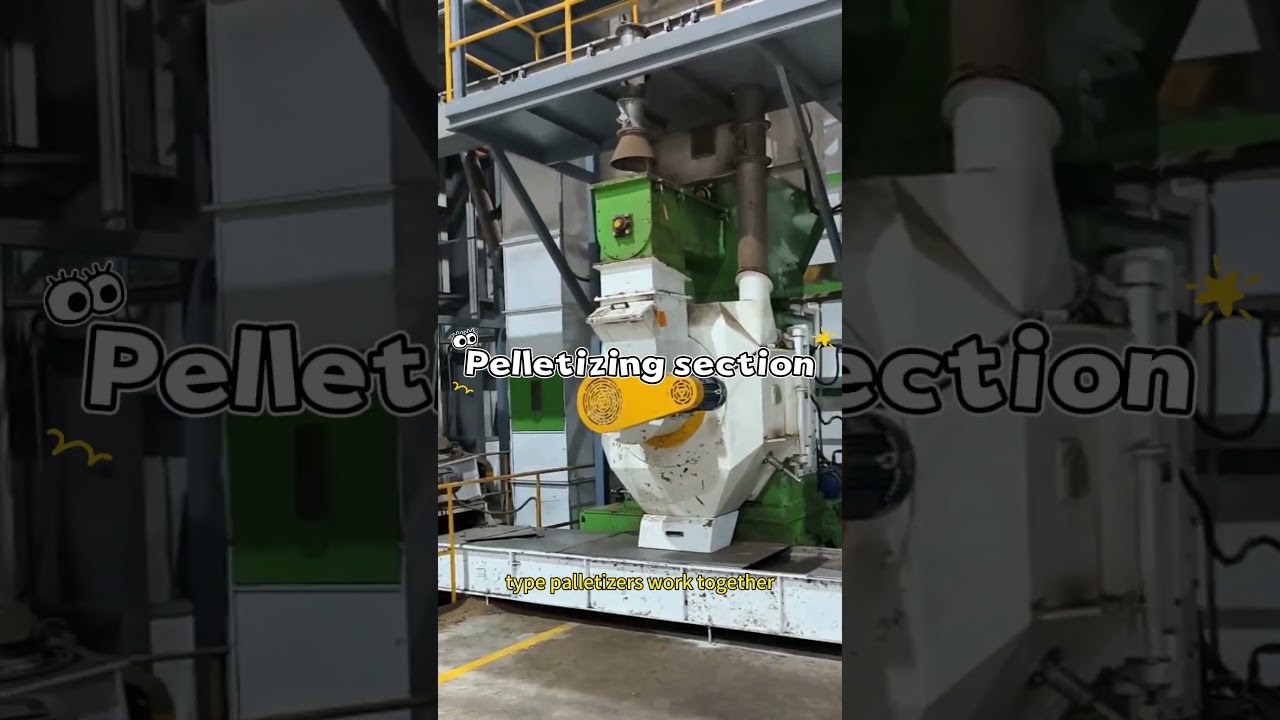
Pelletizing Section Four JZWH-860 horizontal biomass pellet mills operate in parallel. The JZWH-860 is Kingwood’s horizontal ring die model, rated at 4–5 t/h per unit. Running four units in parallel produces a combined pelletizing output that the transcript characterizes as approximately 20 t/h. Stainless steel dust and moisture removal pipes are fitted on top of each pelletizer to prevent fugitive emissions during the extrusion process.
For procurement teams evaluating alternative configurations, Kingwood’s vertical pellet mill range — including the JWZL-928, rated at 4–5 t/h — offers comparable per-unit output in a different mechanical architecture, which may suit facilities with height constraints or different maintenance access requirements.
Project Scope and Output
The full-line throughput figure cited in the transcript is 162 L/TPH, which represents the volumetric processing rate across the integrated line. The pelletizing output is approximately 20 t/h of finished biomass pellets. These two figures are not directly comparable — volumetric throughput at the front end reflects the bulk density of raw logs plus moisture, while mass output at the pelletizing stage reflects dried, densified product.
The overall system was commissioned as a complete wet-feed pellet production line, consistent with Kingwood’s standard complete-line offering, which handles high-moisture biomass from raw input through crushing, coarse grinding, drying, fine grinding, pelletizing, and packaging in a fully automated, enclosed configuration.
The dust management system warrants specific attention for operators subject to particulate emission regulations. A centralized dust collection system collects fugitive dust across the line and recycles 100% of it back to the silo. The transcript explicitly states this achieves “over 99% raw material utilization” — a figure relevant both to environmental compliance and to operational economics, since fine wood dust recovered and pelletized contributes directly to saleable output.
Engineering Highlights
Several design decisions in this project reflect Kingwood’s stated core philosophy of integration, dust-free operation, and automation.
Enclosed conveying throughout. Both the post-crushing transfer and the dryer feed use closed conveying systems. This is not merely a dust suppression measure — it also prevents moisture reabsorption between process stages, which is relevant given the 50% starting moisture of the feedstock.
Parallel pelletizer configuration. Running four JZWH-860 units in parallel rather than a single larger machine provides redundancy: one unit can be taken offline for die maintenance without halting the full line. For a demonstration project intended as a regional template, operational continuity is a design criterion as important as peak throughput.
Integrated safety at the grinding stage. Spark detection and smoke alarms mounted directly on the grinding section represent an active fire risk mitigation approach. Fine wood dust in the 3–10 mm range, combined with the heat generated by high-speed grinding, creates ignition conditions that passive suppression alone cannot adequately address.
Centralized dust recycling. Returning 100% of collected dust to the silo rather than treating it as waste eliminates a disposal cost, reduces raw material input requirements, and simplifies regulatory reporting for the operator.
IEA Bioenergy Task 40’s 2024 outlook notes that industrial wood pellet demand in Asia-Pacific is growing, with new capacity additions increasingly required to meet tighter emissions and efficiency standards. Projects of this specification — high-throughput, enclosed, automated, with documented material utilization rates — are positioned to meet those standards without retrofit investment.
Sources
- YouTube video l488hGmeaUI (Kingwood site footage — transcript-derived technical specifications)
- IEA Bioenergy Task 40, 2024 Bioenergy Outlook — global industrial wood pellet demand figures
- ISO 17225-2:2021 Solid Biofuels — Graded Wood Pellets — moisture content specifications for industrial-grade pellets
→ Explore Kingwood China biomass pellet mill equipment on our main site (kingwood-china.com)